


News

Combining high-speed response, precision micro-dispensing and high repeatability through piezoelectric actuation to enable flexible fluid control solutions for precision manufacturing.
As precision manufacturing advances toward miniaturization, higher integration density and automation, fluid dispensing technologies face increasingly demanding requirements. Achieving precise micro-volume dispensing within limited spaces while maintaining operating speed, process consistency and material compatibility has become an important engineering challenge.
Leveraging the electromechanical conversion properties of piezoelectric materials, piezoelectric jet dispensing technology converts electrical signals into rapid, controlled mechanical displacement, enabling non-contact dispensing of small fluid volumes. By integrating expertise in piezoelectric materials, precision actuation mechanisms and electronic drive control, ADW has developed its PJS Series Piezoelectric Jetting Valves to support high-speed, high-precision and repeatable fluid dispensing.
1. The Fundamentals of Piezoelectric Jet Dispensing: From Electrical Signals to Mechanical Displacement
The fundamental operating principle of piezoelectric jet dispensing is the inverse piezoelectric effect.
When an electric field is applied to a piezoelectric material, the material undergoes mechanical deformation in response to the applied field. By controlling the drive voltage and signal waveform, the displacement and dynamic response of the piezoelectric element can be adjusted to achieve rapid and precise mechanical motion.
ADW incorporates a high-performance piezoelectric stack actuator as the core driving element. Its multilayer structure combines the small displacements generated by individual piezoelectric layers into an effective mechanical output, leveraging the actuator's fast response, high actuation force and controllable displacement. This direct electromechanical energy conversion provides the foundation for high-frequency jetting, precision fluid control and repeatable mechanical motion.
2. Non-Contact Jetting: How Precision Fluid Dispensing Works
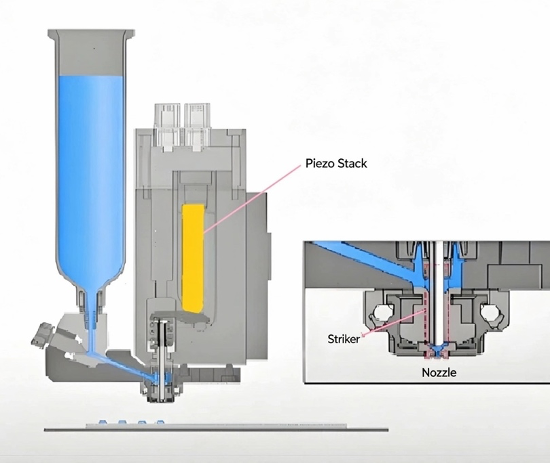
ADW's piezoelectric jetting valves achieve rapid, controlled fluid dispensing through the coordinated operation of the piezoelectric stack actuator, tappet, nozzle and electronic drive controller. The operating process consists of three main stages:
Electrical Actuation
The electronic drive controller applies a controlled voltage signal to the piezoelectric stack, generating rapid expansion and contraction and producing controlled mechanical displacement.
Mechanical Motion and Fluid Pressurization
The piezoelectric stack drives the tappet at high speed, applying a transient mechanical force to the fluid near the nozzle and generating the pressure and kinetic energy required for jetting.
Droplet Formation and Non-Contact Jetting
Under suitable operating conditions, the fluid overcomes surface tension and viscous resistance and is expelled through the nozzle to form discrete droplets without direct contact between the nozzle and the target surface. Through repeated, controlled actuation cycles, the system enables repeatable jetting. Parameters such as the drive waveform, jetting frequency, tappet motion and nozzle geometry can be optimized to achieve precise control of droplet formation and fluid dispensing.
Compared with conventional contact dispensing, non-contact jetting reduces repetitive vertical approach and retraction movements, helping shorten dispensing cycles and minimize contact-related process limitations.
3. Key Advantages of ADW Piezoelectric Jet Dispensing Technology
High-Speed Response and High-Frequency Jetting
The rapid electromechanical response of piezoelectric actuators enables fast conversion of electrical signals into mechanical motion, providing the foundation for high-frequency jetting. Through the coordinated design of piezoelectric actuation and precision mechanical structures, ADW supports rapid, successive jetting cycles, helping shorten dispensing cycles, improve throughput and meet the requirements of high-speed automated processes.
Precision Micro-Dispensing and High Repeatability
Precise control of the piezoelectric drive signal and mechanical motion enables repeatable dispensing of small fluid volumes. Optimizing drive parameters and the jetting process helps control droplet size and dispensing volume, minimize jetting variations and improve process consistency, supporting quality control in precision manufacturing.
Non-Contact Design for Greater Process Flexibility
Non-contact jetting eliminates the need for direct nozzle-to-substrate contact, helping reduce the risk of mechanical interference, surface damage and unintended material transfer.
Reducing repetitive vertical motion also supports more efficient dispensing paths and provides greater flexibility in equipment design, spatial layout and process configuration.
Broad Viscosity Compatibility
Fluid viscosity, surface tension and rheological properties are important factors influencing droplet formation, jetting stability and dispensing consistency.
By matching and optimizing drive parameters, nozzle geometry and fluid channels, ADW's piezoelectric jetting systems can accommodate materials with different viscosities and rheological characteristics, supporting diverse precision fluid dispensing requirements.
4. From Core Components to System Control: ADW's In-House Technology
High-performance piezoelectric jetting depends not only on the actuator itself but also on the coordinated interaction of material properties, mechanical design, fluid dynamics and electronic drive control.
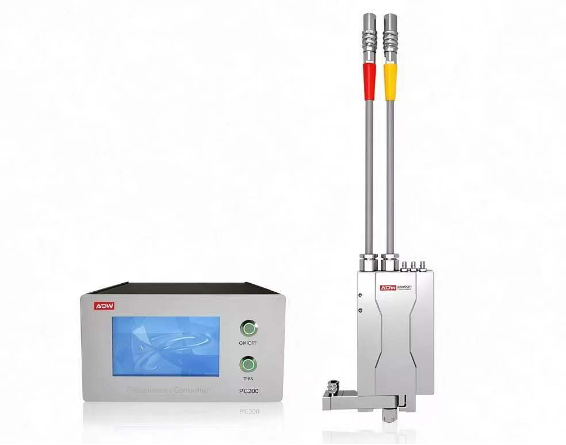
ADW's in-house development capabilities encompass piezoelectric stack actuators, jetting valves and electronic drive controllers, enabling integrated optimization of piezoelectric actuation, mechanical response and jetting performance.
Piezoelectric Stack Technology
Piezoelectric material selection and multilayer actuator design provide rapid, controllable mechanical displacement and actuation force.
Precision Jetting Valve Design
The coordinated design of the tappet, nozzle and fluid channels optimizes the transfer of mechanical energy into fluid motion, supporting stable droplet formation and repeatable jetting.
Electronic Drive and Parameter Control
The electronic drive controller supports configurable jetting parameters, dot and line dispensing modes, remote communication and PLC triggering, providing flexibility for automated system integration and process parameter management.
By developing core components and complete jetting systems in-house, ADW can optimize the overall system architecture to accommodate different fluid characteristics and precision control requirements.
5. Advancing Precision Fluid Control Through Piezoelectric Technology
Advances in precision fluid control extend beyond smaller dispensing dimensions and higher jetting efficiency. They also involve continuous improvements in process controllability, repeatability and system integration.
With its rapid response, precise displacement control and high-frequency actuation capabilities, piezoelectric technology offers an effective approach to non-contact precision dispensing.
ADW continues to advance piezoelectric materials, actuator design, precision fluid control and electronic drive technologies. Through integrated component and system-level engineering, ADW aims to further improve jetting performance, process adaptability and operational stability, delivering efficient and flexible fluid control solutions for next-generation precision manufacturing.
Looking for a Precision Piezoelectric Jet Dispensing Solution?
Contact us at info@adwsensor.com and share your company and contact details, fluid material type, viscosity range, target dot size, required jetting frequency, precision requirements and project development stage. Technical specifications, material properties, engineering drawings and preliminary test data are also welcome to help our technical team evaluate a suitable solution for your project.
 Come Back