

News

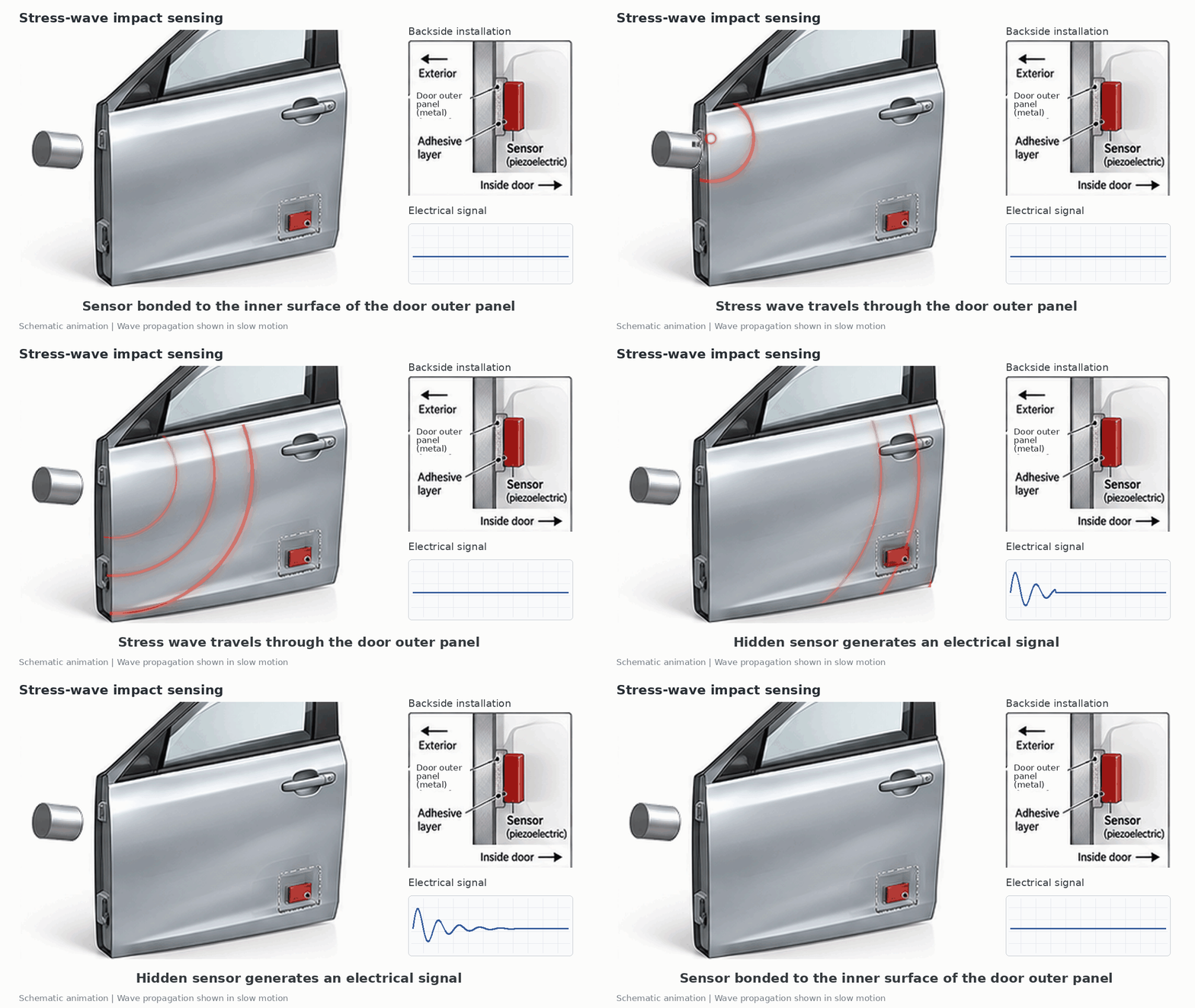
As robots, autonomous vehicles and intelligent systems operate in increasingly complex environments, detecting obstacles before contact is only part of the sensing challenge. Detecting unexpected physical contact can provide additional information for motion control, collision response and event analysis. ADW’s piezoelectric stress-wave sensing technology converts dynamic mechanical disturbances transmitted through a structure into electrical signals for processing. When an impact occurs, stress waves can propagate through a panel and reach a piezoelectric sensor bonded to its inner surface.
By using the structure itself to transmit mechanical information, this approach offers the potential to detect impacts at multiple locations with a limited number of strategically positioned sensors, without requiring a separate sensor at every potential impact point. Actual coverage depends on the structure and must be validated for each application.
1. Key Technical Advantages
- Structural wave propagation: A sensor may detect impact-related responses transmitted through a panel, even when the impact occurs away from its mounting point.
- Potential coverage with fewer sensors: Appropriate sensor placement and signal processing may enable detection across multiple impact locations. Coverage and localization capability require application-specific testing.
- Ultra-thin design: The sensing element has a nominal diameter of approximately 9 mm and a total thickness of approximately 0.24 mm, supporting integration into space-constrained assemblies.
- Concealed installation: Bonding the sensor to the inner surface of a suitable panel can preserve the external surface design while enabling contact-event detection.
- Dynamic event detection: Electrical signals can be analyzed to identify impact-related events. System response and reliability depend on sensor mounting, signal acquisition, processing algorithms and controller performance.
2. Sensing Principle and Application Considerations
When an impact occurs, the resulting mechanical disturbance propagates through the structure as stress waves. A bonded piezoelectric sensor converts the transmitted dynamic deformation into an electrical signal. With suitable placement, a limited number of sensors may detect impacts beyond their immediate mounting locations.
The effective sensing area depends on material properties, panel geometry, thickness, structural damping, joints, adhesive coupling and impact conditions. The output signal represents the mechanical response received at the sensor; it does not directly measure absolute impact force or structural damage. Coverage, localization accuracy and detection reliability must be established through application-specific testing.
3. Core Application Scenarios
Automotive Systems: Body-Panel Impact Detection
A sensor bonded to the inner surface of a suitable vehicle panel may detect mechanical disturbances generated by impacts occurring elsewhere on the same structure. Strategic placement may allow a limited number of sensors to monitor multiple potential impact locations across doors, bumpers or other body components.
Detection coverage and impact-location estimation depend on panel material, geometry, thickness, joints and impact conditions. This technology can complement existing vehicle monitoring systems but does not replace required vehicle safety systems.
Industrial Robotics: Collision Detection
Sensors installed inside suitable robot housings or near vulnerable structural areas can detect collision-related mechanical responses. Processed signals may support predefined control responses, such as deceleration commands, stopping requests or inspection alerts.
Distinguishing normal task-related contact from unexpected collisions requires application-specific testing and signal-classification algorithms.
AGVs and AMRs: Contact-Event Monitoring
Sensors integrated behind suitable bumper structures or at selected vehicle locations may detect contact events transmitted through the chassis. This provides an additional source of physical-contact information alongside LiDAR, cameras and other perception technologies.
Detection reliability and vehicle stopping performance must be validated under representative operating conditions.
Embodied AI and Service Robotics
Stress-wave sensing may enable concealed contact detection through robot housings and structural components. When combined with visual perception, joint torque data and other inputs, impact-related signals may help identify unexpected physical interactions and support event analysis.
This technology should be evaluated as part of a broader perception and control architecture, not as a standalone solution for comprehensive tactile perception or functional safety.
4. Conclusion
ADW’s piezoelectric stress-wave sensing technology offers a compact approach to exploring concealed collision detection in automotive structures, industrial robots, AGVs, AMRs and embodied AI systems.
By combining structural sensing with appropriate signal processing and system-level validation, developers can explore how physical-contact information can complement existing perception and control systems.
Evaluating a stress-wave sensing solution for your project?
Contact info@adwsensor.com and include your company and contact details, target application, structural material and thickness, potential impact locations, expected impact conditions, required detection coverage, available installation space and project stage. Drawings, samples or preliminary test data can also help us assess sensor placement and an appropriate evaluation plan. Suggested email subject: Stress-Wave Impact Sensing Application Evaluation.
 Come Back