


News

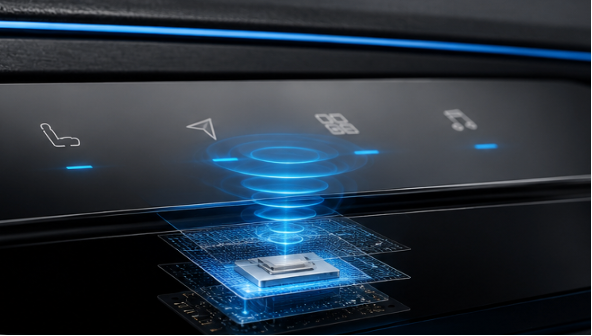
As smart cockpits, wearable devices, and high-end industrial terminals demand minimal aesthetics, IP69K-level protection, and maximized spatial efficiency, the physical limitations of traditional mechanical switches (Tact Switches) and conventional capacitive touch sensors have become increasingly prominent. Drawing upon deep expertise in piezoelectric materials science, ADW has launched the Piezoelectric Haptic Platform. Combining direct piezoelectric pressure sensing with converse piezoelectric high-fidelity haptic feedback, this platform enables a solid-state, seamless "Sensor & Actuator" interaction model. It opens up new design dimensions for global OEM clients—namely, "Software-Defined Haptic Feedback" and "Seamless Smart Surfaces".
1. Industry Context & Design Bottlenecks: Evolution of HMI Architectures
Throughout the development of Human-Machine Interfaces (HMI), engineering teams have continuously strived to balance tactile determinism, visual seamlessness, and structural reliability:
Traditional Capacitive Touch (Capacitive Touch): Enables seamless, cutout-free designs and multi-touch gesture sensing, but lacks passive tactile feedback, leading to accidental touches. Adding haptic feedback requires mounting external Eccentric Rotating Mass (ERM) or Linear Resonant Actuator (LRA) motors, which drastically increases system volume (often 3–5 mm in height) and power consumption.
Switch Technology | Traditional Mechanical Switch | Capacitive Touch + Motor | Piezoelectric Haptic Platform |
Core Mechanism | Metal dome deformation | Capacitive field change + External motor | Piezoelectric effect (Direct + Converse) |
Panel Cutout | Required (IP rating limited) | Cutout-free (IP67/68) | Seamless & Cutout-free (IP68/IP69K) |
Haptic Feedback | Fixed passive click | Motor-driven vibration (bulky) | Active, HD, & Software-definable |
Thickness / Profile | Standard (~3–6 mm) | Bulky (~3–5 mm) | Ultra-thin (0.3–2.0 mm) |
Operating Life | Medium (subject to fatigue) | High (sensor) / Medium (motor) | > 50 Million cycles (Zero wear) |
2. Core Technical Principle: Integrated Sensor & Actuator Solid-State Platform
The ADW Piezoelectric Haptic Platform bridges the physical gap between sensors and actuators by leveraging the dual electro-mechanical properties of piezoelectric materials within a single component:
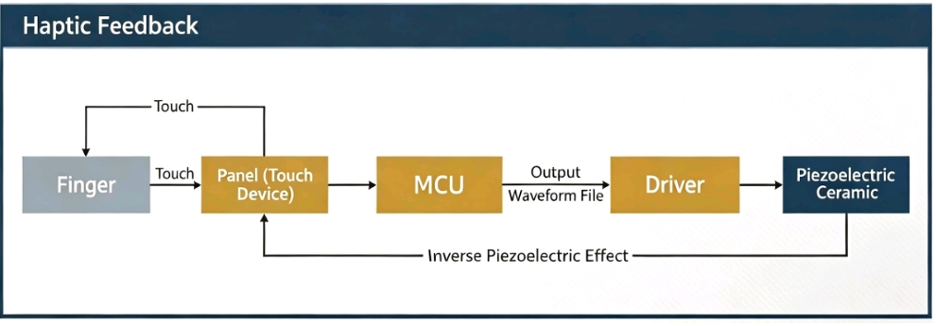
· Direct Piezoelectric Effect (Z-axis Force Sensing): When a user presses a seamless panel, the micro-level deformation exerts pressure on the underlying piezoelectric material, instantly producing a micro-volt level voltage signal. Combined with DSP algorithms, the system evaluates press force and rate of change, eliminating accidental touches caused by surface water, oil stains, or gloved operation—a notorious draawback of capacitive touch.
· Converse Piezoelectric Effect (Active Haptic Feedback): Once the press force reaches the set threshold, the driver circuit injects a high-voltage pulse waveform to the piezoelectric element within microseconds (<1 ms). The material instantaneously deforms to push against the panel, generating a transient acceleration of tens of Gs against the user's finger, delivering a precise "virtual click" confirmation.
3. Key Engineering Advantages of the Piezoelectric Platform
4. Target Application Scenarios & Implementation Pathways
Target Sector | Application Scenarios | Technical & Business Value |
Automotive HMI | • Smart steering wheel controls • Hidden door & center console keys • Anti-mis-touch HVAC touch panels | It creates seamless smart surfaces across leather and wood finishes, delivering context-aware haptic feedback that effectively eliminates accidental input while accentuating cabin luxury. |
Smart Wearables | • Solid-state side keys on smartwatches • Solid-state crown haptic simulation • Ultra-thin haptic smart rings | It replaces mechanical crowns and stems, eliminating water ingress points to achieve a 50-metre-plus dive rating, whilst saving critical internal space for the battery. |
Subsea & Harsh Environments | • Seamless buttons for diving computers • Underwater camera shutters • Subsea control handles | It completely eliminates the need for panel cutouts and the risk of O-ring seal failures, preventing buttons from jamming or locking up under high pressure. |

5. ADW Commercial Product Portfolio & Ecosystem Support
Featured Product Series:
To assist clients in evaluating drive circuits and anti-accidental touch algorithms, ADW collaborates with leading low-power high-voltage driver IC partners to offer one-stop integration support, including Starter Kits, low-level driver SDKs, and reference circuit designs.

6. Technical Consultation & Contact Us
Whether you are planning next-generation HMI interfaces, exploring seamless smart surfaces, or evaluating piezoelectric touch reliability for extreme conditions, the ADW Engineering Team provides comprehensive technical support—ranging from material selection and panel deformation simulation to haptic waveform tuning and prototype validation.
Feel free to reach out to our Field Application Engineering (FAE) team for product datasheets, samples, and evaluation kits:
 Come Back