

News

In a crowded urban parking lot, a D-class luxury sedan smoothly backs into a narrow space only 20 centimeters longer than the car itself. Behind this scene are ultrasonic sensors on the front and rear bumpers, flashing almost simultaneously yet without interfering with each other, performing precise calculations.

As intelligent parking assistance becomes a standard feature in mainstream vehicles priced between 100,000 and 200,000 yuan, the demand for reliable, efficient, and cost-effective short-range sensing solutions has reached unprecedented levels.
## The Sensing Dilemma in the Intelligent Parking Wave
The competition in automotive intelligence is shifting from the first half—electrification—to the second half—intelligence. Advanced functions such as Automatic Parking Assist (APA) and Remote Parking have become core considerations for consumers when purchasing cars.
Market research shows that by 2025, the global market size for intelligent parking assistance systems is expected to reach **USD 2.326 billion**.
However, behind this widespread adoption lie stringent technical challenges. Traditional ultrasonic radar solutions often struggle in complex scenarios.
When traditional ultrasonic radars operate, to avoid same-frequency interference, multiple sensors on the same bumper must “queue” to transmit ultrasonic waves in turn. This serial working mode directly extends the system refresh cycle, slowing data updates. When a vehicle rapidly approaches obstacles or executes complex parking trajectories, delayed information can pose risks.
## From “Taking Turns” to “Simultaneous Interpretation”: The AK2 Revolution
The core breakthrough of AK2 technology lies in its unique ultrasonic signal encoding method, which completely changes the working logic of ultrasonic radar.
Traditional radars can only send monotonous signals at a fixed frequency, while AK2 allows each sensor to transmit encoded signals with unique “identity tags,” such as up-chirp or down-chirp signals.
This is like turning a meeting from “speaking in turns” into “simultaneous interpretation with multiple channels.” Multiple sensors can transmit and receive at the same time, and the system can decode and distinguish each sensor’s echo.
The direct effect is astonishing: the refresh time for a single bumper detection is compressed to **within 40 milliseconds**, multiplying system efficiency. This means the vehicle’s perception of its surroundings is updated almost in real time, providing a smoother and safer decision-making foundation for intelligent parking systems.
## Performance Leap: Comprehensive Superiority in Three Dimensions
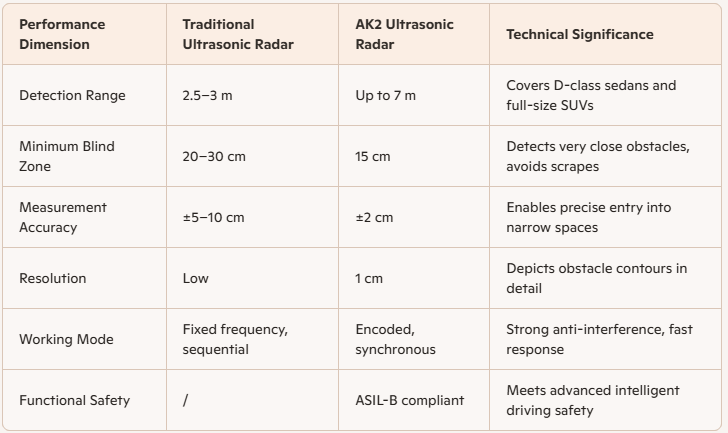
AK2 is not just a change in working mode—it achieves comprehensive superiority over the previous generation in key performance indicators.
- **Extended detection capability**: With a 7-meter range, AK2 suits not only compact cars but also D-class luxury sedans and SUVs up to 6 meters long.
- **Unprecedented precision**: ±2 cm accuracy and 1 cm resolution allow the system to clearly perceive curbs, low railings, or even children’s toys—critical for “one-shot parking” in tight spaces.
## Core Technology Analysis: Encoding, Ranging, and Functional Safety
AK2’s advantages rest on three pillars: **encoded signal processing, intelligent near/far ranging, and systematic functional safety design.**
- **Encoding technology**: With an 8 kHz modulation bandwidth, AK2 can dynamically adjust frequencies like radio frequency hopping, effectively avoiding environmental noise and greatly improving reliability in complex acoustic environments.
- **Smart ranging logic**: AK2 switches between “long-range scanning” and “short-range precision” modes depending on the scenario. It scans broadly when searching for spaces, then shifts to high-precision mode for the final centimeters of parking.
- **Functional safety**: Developed strictly under ISO 26262-2018 standards, AK2 meets **ASIL-B** requirements. It features hardware redundancy (dual-core heterogeneous architecture) and full-stack safety processes from chip to software. A real-time self-diagnostic system continuously monitors echo quality, temperature, and sensor status, ensuring potential faults are detected and handled promptly.
## Reshaping the Industry Landscape and Future Outlook
The emergence of AK2 ultrasonic radar is reshaping the low-speed intelligent driving perception field. Its value lies not only in performance improvements but also in offering the industry a **higher-performance, more reliable, and cost-effective sensing solution.**
By reducing reliance on expensive sensors such as certain LiDAR units, AK2 accelerates the democratization of advanced parking functions in mainstream vehicles.
Looking ahead, AK2’s encoded and safety-enhanced ultrasonic radar will integrate more deeply with surround-view cameras and millimeter-wave radars.
In the trend toward **“integrated driving and parking”**, AK2’s high refresh rate and high-precision short-range data will become indispensable, jointly building safer and smoother all-scenario intelligent driving experiences.
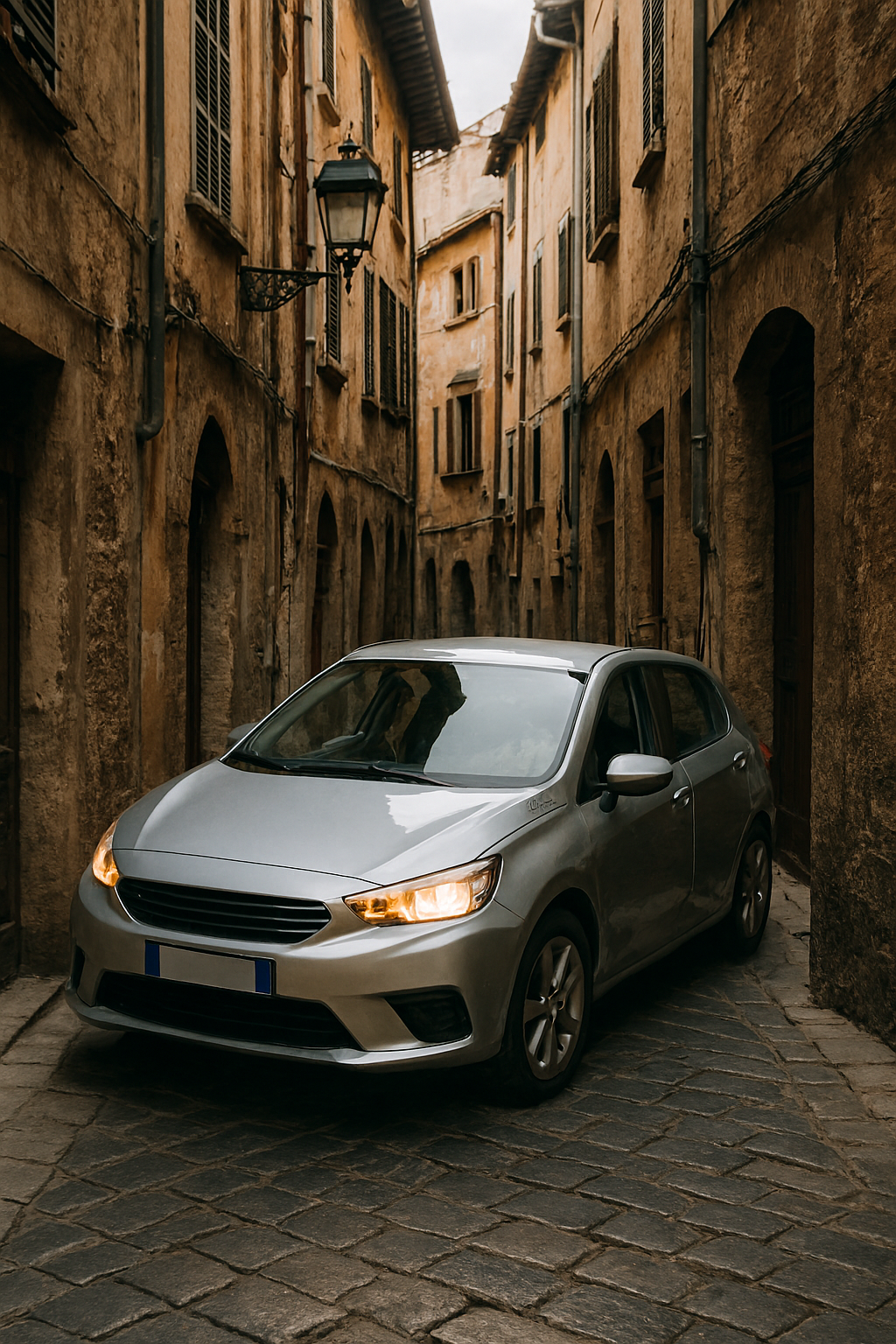
When a car equipped with AK2 ultrasonic radar effortlessly navigates narrow old-town streets and parks precisely in seemingly impossible spaces, the precise calculations are happening silently in the background. Each sensor no longer emits simple sound pulses, but data packets carrying unique identity codes.
This marks the transition of automotive perception technology from the vague era of “sensing” into the precise, concurrent, and safe era of **“cognition.”**
 Come Back